
Do you see error messages such as "timeout" or "packet (or connection) loss"? You may have checked your network traffic with Wireshark and noticed many unusual, very short packets, yet you still have no idea what's happening - even though your server already has some form of DDoS protection in place.
This is a very common situation today. Security experts investigating such cases often discover a sophisticated type of DDoS threat known as an application-layer (Layer 7) attack. Traditional Layer 3/4 DDoS attacks overwhelm servers with massive volumes of packets - like a traffic jam on the highway. Layer 7 attacks are smarter: imagine one person with 30 phones making 30 simultaneous calls to a single call center. The call center becomes jammed and can't answer real customers.
If your connection (or slot) limit is 128, a single attacker's PC generating 128 fake connections can overwhelm the server - even without huge bandwidth. One computer simulating many fake players can bring a FiveM server down.
Cloud-based protection is not effective against application-layer attacks because it sits upstream, before your endpoint servers, and cannot analyze the subtle attack patterns at the application layer. Anti DDoS Guardian runs directly on your endpoint servers, inspecting local traffic and application-layer data - giving it a unique advantage in defending against Layer 7 DDoS attacks.
Anti DDoS Guardian stops sophisticated Layer 7 attacks using:
These measures identify fake connections, terminate malicious sessions, and keep legitimate players safe within a protected IP pool.
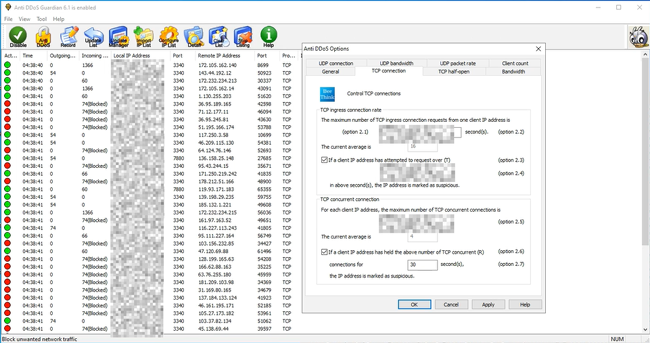
As shown in the image, DDoS traffic (in red) was detected and blocked during a real attack. Initially the administrator experienced lag and freezes without realizing it was a DDoS attack. With Anti DDoS Guardian, every malicious packet becomes visible.
Many game server managers have achieved excellent results by combining cloud-based protection with Anti DDoS Guardian.
Protect your game servers now - try Anti DDoS Guardian for free now.